Read our reviews...
9am to 6:30pm Monday to Friday | Saturday 9:30am to 1:30pm
Call Get an instant quote
*Price Guarantee *Free Delivery *Personalised Finance

Read our reviews...
*Price Guarantee *Free Delivery *Personalised Finance
Electric Vans / Electric Van Reviews / Farizon SV Review
It’s not just the passenger car market that is being inundated with competitors from China and East Asia. We’re now seeing new entrants in the van sector, which are causing some serious concern to the established players. Enter stage left, the Farizon SE. Our Van Expert Tim Cattlin has recently spent some time with the van…
Farizon might not be a name familiar to most but Volvo, Lotus and Polestar probably are. What do they have in common? They’re all owned by Chinese conglomerate, Geely. Farizon, formed in 2016, is focused on commercial vehicles from vans to trucks and buses. The SV was launched in the UK at the Commercial Vehicle Show in 2025, imported and distributed by Jameel Motors, a well-established vehicle importer.
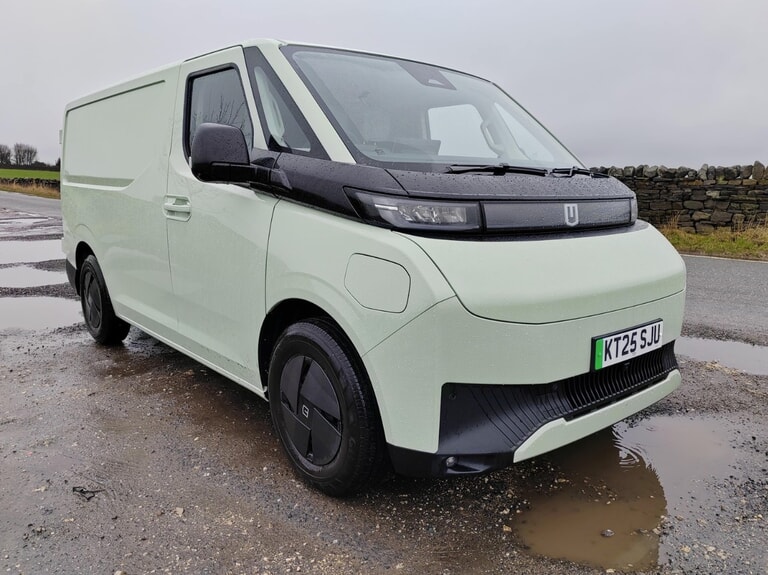
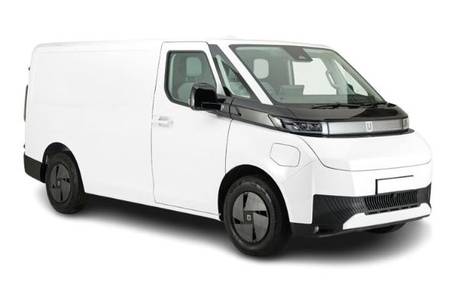
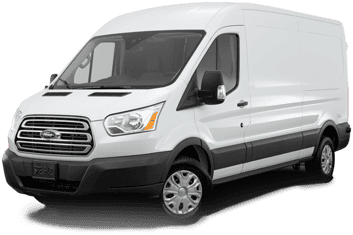
The all-electric SV (it stands for ‘Super Van’) fits somewhere between two traditional market sectors. The L1H1 model is broadly comparable to the Ford E-Transit Custom, whereas the longer and higher versions are more akin to the ‘full fat’ E-Transit, albeit the smaller versions. Unlike the Custom though, all SV’s are rated at 3500kg GVM, allowing for a decent payload.
From a bodystyle perspective, the SV range is comprehensive. There are L1, L2 and L3 lengths, and H1 H2 and H3 heights, although not all permutations are offered. L1 just gets the low and medium roofs, L2 is available with medium and high heights, whilst the longest L3 model just gets the highest roofline.
There’s a single trim level, making life a bit easier for the prospective purchaser.
There’s just a single motor but, with a more than adequate power output of 231PS and providing 336Nm of torque. You’ve a choice of three battery packs, rated at 67kWh, 83kWh and, available only on the L3H3 van, a 106kWh version. That all-important range from a full charge? Under the WLTP Combined test cycle, the 67kWh battery pack achieved a result of up to 204 miles, the 83kWh 234 miles and the 106kWh 247 miles.
Charge times on an 11kW AC wallbox are 6.5, 9 and 10.5 hours respectively, and a DC 120kW public charger will get you from 20% to 80% in around 40 minutes. Top speed on all versions of the SV is 84mph with a 0-62mph time of 12 seconds.
The beauty of the single trim level is that SV owners get everything. There’s a reasonable level of standard equipment, including a 12.3” multi-media unit. Although this offers Apple CarPlay, Android owners are not properly catered for, a third part app not really cutting the mustard. From a safety tech perspective, there’s little missing and the now mandatory suite of products is joined by adaptive cruise control, blind spot detection, 360 degree surround view, front and rear parking sensors and reverse camera.
Automatic air conditioning is included, and the windscreen, driver’s seat and steering wheel are all heated.
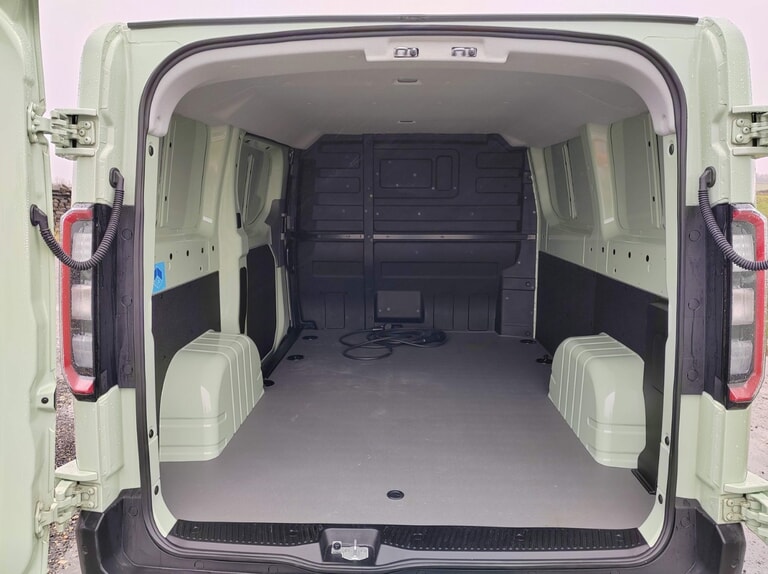
Some highlights on dimensions. Load lengths to the bulkhead are 2690mm / 3190mm for the L1 and L2, a width of 1795mm (1387mm between the wheelarches) and 1440mm / 1640mm of H1 and H2 height. Load volumes range from 6.95cu/m to 13.0cu/m. The load height is a handy 550mm. Be aware that, at the time of writing the official Farizon brochure has some errors in the dimensions and payloads listed and care should be taken when making purchasing decisions on the information provided. Payloads are from 1035kg to 1350kg, depending on battery pack and body derivative, towing capacity is 2000kg.
A left side door and twin rear doors are standard, although a 270 degree opening facility is optional. The SV is unique in that, behind the passenger, there is no ‘B’ pillar. In theory, this would provide easier loadspace access, but this is limited by the bulkhead, so advantages are few. So, where is the passenger seatbelt located, you may wonder. It’s actually mounted on the passenger door, so remind friends to unclip the belt prior to opening the door…
The operator will find 3-pin mains sockets in the loadspace providing 3.3kW of power for operating tools etc, and a first as standard equipment is a load monitoring system with a readout on the dash alerting drivers if maximum GVM is being approached.
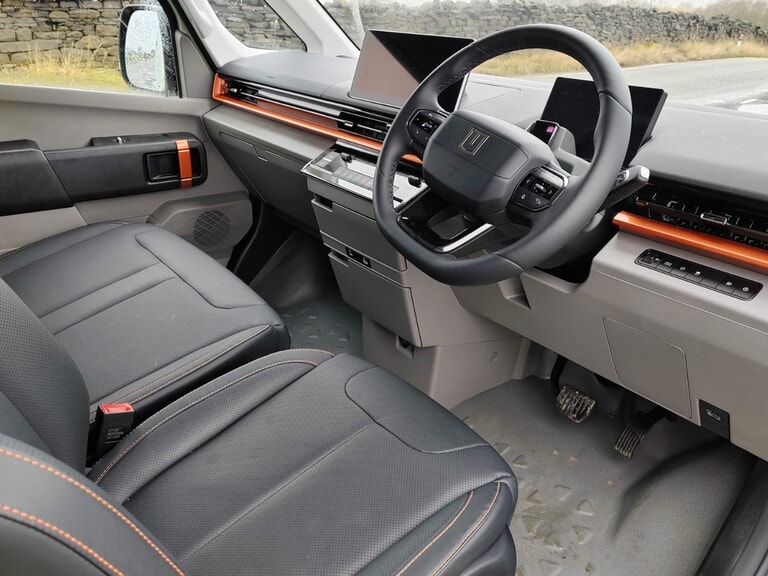
First impressions? It’s very wide, much more comparable to a Mercedes-Benz Sprinter or other large van than the likes of a Transit Custom. There’s plenty of room for three adults without feeling ‘snug’. The dash? Perhaps an acquired taste. There’s the very ‘landscape’ centrally mounted multimedia unit, a modestly sized electronic instrument panel and a weird heat and ventilation control panel under the main dash, in the centre. Looks are subjective, and personally I didn’t warm to the layout, it seeming like a bit of a mish-mash and put together without a single aim. The media unit is OK, reasonably simple to operate but a bit laggy at times. The instrument panel again seemed to lack direction, almost offering too much information. For instance, there’s a large, permanent display of not only tyre pressures but also tyre temperatures. It just seemed cluttered, messy and a bit like some sort of ‘Temu’ aftermarket product. It’s nice to see mechanical heater controls, although I failed to get much warmth out of the heater, possibly a vehicle fault or, more likely operator error…
Cab storage is poor. There are no overhead compartments and no trays on the dash. There’s a modestly sized glovebox, but door bins are small, and the pull out cupholder / oddment holder seems frail and I doubt it would last long in a busy working van. The materials generally feel cheap, and that’s perhaps an overall impression of the cab, almost as if the manufacturer had run out of money at the end of the design brief.
There’s no shortage of performance from that powerful motor but, here the driver might become aware of the drive-by-wire technology that Farizon is pioneering with the van. There are few physical connections between driver and the vehicle and there’s a slight lag between putting your foot down and the motor responding. It’s something I got used to, however. This tech applies to steering, too, but I wouldn’t have known, the van feeling just like any other in this respect.
Road and wind noise are minimal and the now mandatory bongs from the safety tech are less intrusive and annoying than they are on some competitor vehicles. The ride, whilst firm fell within what I’d take as acceptable parameters for a van, especially as tested unladen. There are various levels of regenerative braking, the driver able to select the setting that they are most comfortable with.
Visibility, whilst great when looking ahead through the large windscreen is poor when manoeuvring thanks to the double a-pillars, separated by a small but mostly useless window. The driver will find themselves moving their head frantically forward and backward trying to avoid obstructions. It’s really not great at all.
Did I love the van? To be honest, no, but I didn’t hate it either. On paper there are very few shortfalls. Power, range, payload, safety tech and driver comforts are all there. But, the cab lets it down, the quality of almost every aspect falling well short of mainstream competitors such as the Ford E-Transit Custom (although when comparing, remember that 3500kg GVM that the Farizon boasts). But, I hear you say, it’s bound to be a lot cheaper? No, and this is perhaps the SV’s biggest Achilles heel. The range starts at £40,000 + VAT after the Plug-In Van Grant has been taken off. That’s in (or even over) the territory of some excellent competitors.
With it’s Euro NCAP 5-Star rating, and plethora of safety tech included, the SV will provide a fleet operator with reassurance that they are providing their drivers with a safe working environment and a 4-year 120,000 mile warranty will soften potential repair bills, although servicing is required annually.
Whilst it’s not a bad van at all, it’s probably not one I’d buy for my own business.