Read our reviews...
9am to 6:30pm Monday to Friday | Saturday 9:30am to 1:30pm
Call Get an instant quote
*Price Guarantee *Free Delivery *Personalised Finance

Read our reviews...
*Price Guarantee *Free Delivery *Personalised Finance
Electric Vans / Electric Van Reviews / Ford E-Transit Courier Review
The popular and often critically praised Transit Courier. Ford’s smallest van is now offered with a fully electric powertrain. Our Van Expert Tim Cattlin has recently spent a week with one and was impressed. Here’s his report.
When Ford originally introduced the modern day Courier back in 2014, many of us wondered where it fit. With a modest payload and a loadspace larger than the likes of the Peugeot Blipper but smaller than the Citroen Berlingo it had no obvious competitors. As a result, it didn’t find favour with fleets and wasn’t a huge seller. But, the all-new Courier addresses these things, and the van competes fairly and squarely with some more well established competitors. Now, with an all-electric powertrain, Ford has, on paper at least, a worthy contender in the zero-emission small van sector.
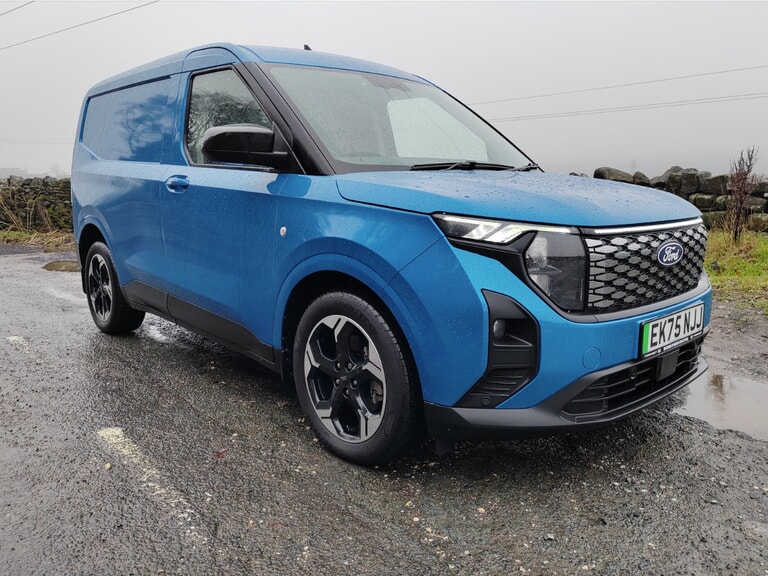
Ford makes life easy for the prospective E-Transit Courier buyer. There’s a single bodystyle (no long wheelbase or high roof options here), just one weight and, although the petrol and diesel versions are offered in four trim levels, electric Couriers are only available in the Trend and Limited derivatives. That’s probably no big deal to most, as the two missing are the base, fleet spec Leader and the Active, aimed at those working in more challenging environments.
The electric motor, rated at 136PS drives the front wheels, and, after a recent update the van has a 46kWh battery. This gives the van a WLTP Combined Cycle test range of 207 miles on a full charge, up from the 181 miles provided by the previously fitted 43kWh pack. The 100kW internal charger means that, plugged into a suitable public DC charger, the Courier can be topped up from 10% to 80% of capacity in under 30 minutes. For those with a head for numbers, the energy consumption is stated as 17.1 kWh/100km, and miles per kWh is 4.2. Top speed is reported to be 90 mph.
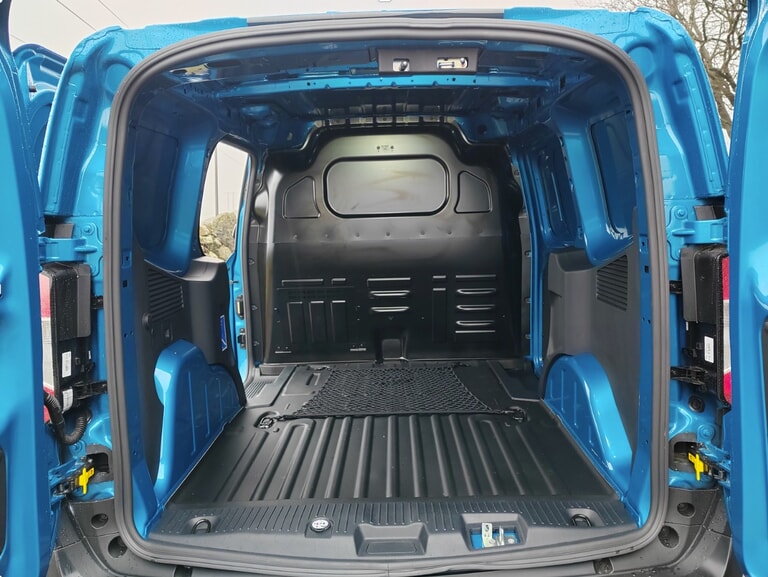
This is a ‘proper’ van, with none of the compromises you get with a car derived vehicle (although the underpinnings are inherited from the Puma passenger car). So, you get a very useable loadspace and a decent payload. Some numbers: There’s 1802mm of cargo length at floor level, although the load through bulkhead increases this to 2661mm. Maximum floor width is 1535mm, reduced to 1220mm between the wheelarches, and there’s an internal height of 1262mm. All this equates to a loadspace measuring 2.9 cubic metres. Notably, thanks to that wheelarch dimension, you’ll be able to get two Europallets in the loadspace. There’s space under the bonnet for storage, too.
The payload of the E-Transit Courier is 683kg, comparing well to the diesel vans capacity. Towing weight is a disappointing 750kg, a figure that could leave some operators wanting. The standard access arrangement is by a single side and twin rear doors and a steel bulkhead protects the cab occupants from shifting loads.
In the cab of the Trend model, there’s a 12” touchscreen with Apple CarPlay / Android Auto smartphone compatibility and climate control. All the latest driver safety aids are present and correct, and there’s a reverse camera and parking sensors. On the outside, the van has LED daytime running lights and taillights, and above the black front grille there’s what Ford calls a ‘Coast-to-Coast’ lightbar.
Move up to the Limited spec and the cab gets heated seats and steering wheel, wireless phone charging, and automatic headlights and wipers. On the outside, powered door mirrors are body coloured and there are some smart 17” alloy wheels.
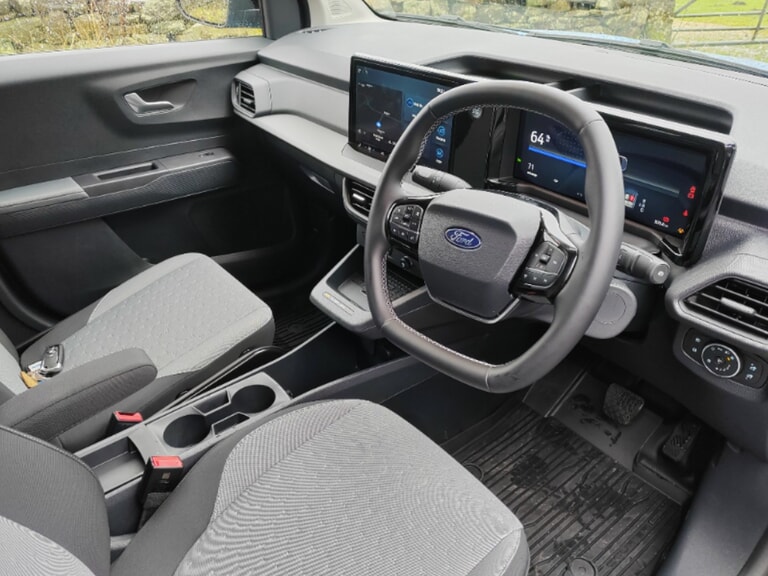
First impressions? It’s nice and roomy, although if Ford ever considered adding a bench seat for a third occupant, things would be more than snug. It’s light and airy, not claustrophobic like some vans can feel. The dash features the large multimedia unit that blends seamlessly into the digital instrument panel, and storage for a small van is excellent. There’s a small shelf at roof height, some trays on top of the dash, various receptacles around the centre console, a glovebox and some modestly sized door bins. The phone charging pad is sensibly placed, and many will welcome the provision of not only the ubiquitous USB-A socket, but also the more modern USB-C variety, Ford, unlike some other manufacturers catering for legacy devices in addition to up-to-date tech.
Coincidentally, I’ve recently become the owner of a Ford Puma, a car which drives impeccably. So, it was little surprise to find that the E-Transit Courier handled in the same way. Superb, precise steering, not too light or heavy, and cornering like the van was on rails. Even unladen, the ride is ‘firm but fair’, perfectly comfortable even on roads with a few bumps. I couldn’t find fault in any aspect. Noise levels from tyres and wind were minimal.
The same goes for the performance offered by the electric drivetrain. Due to the maximum torque always being available, the acceleration is rapid, and in the damp weather experienced whilst I had the van, brief episodes of wheelspin were commonplace if encouraged.
Visibility is first class from the large windscreen, and the instruments, providing the usual blend of information for the electric vehicle driver is clear and unambiguous.
The driver is offered the choice of a number of driving modes, such as Eco, Sport and Slippery, allowing aspects to be tailored to the prevailing driving conditions.
One annoyance is that Ford has followed a trend to include heating and ventilation controls within the touchscreen. Try doing that whilst on the move, it’s a real distraction, bordering on dangerous. Give me quick to find and adjust physical controls any day of the week.
2 year service intervals with no mileage limit mean routine dealer visits will be few and far between, and there’s a 3 year / 60,000 mile warranty. The battery is warranted for 8 years / 100,000 miles.
This is a great little van with, incidentally, a Euro NCAP Platinum safety rating, the top tier. It takes a decent load, drives well, and that powertrain provides performance no one will complain about. But, these days that maximum range is starting to look uncompetitive and, in my (and my delivery driver’s) experience a little optimistic, even taking into account weather and driving conditions, which will always eat away at that remaining distance before a top up is needed. Today, the % remaining shows at 64%, which sounds pretty good. Then you see that that has translated to just 71 miles which, bearing in mind you’re unlikely to want to let it get to zero, means that you’ll soon need to consider finding a chargepoint. But, for a small business operating locally and with a home or work charger, this maximum range is unlikely to be an issue.