Read our reviews...
9am to 6:30pm Monday to Friday | Saturday 9:30am to 1:30pm
Call Get an instant quote
*Price Guarantee *Free Delivery *Personalised Finance

Read our reviews...
*Price Guarantee *Free Delivery *Personalised Finance
Electric Vans / Electric Van Reviews / Ford Transit Custom PHEV Review
Britain’s best-selling van, the Transit Custom, is now offered as a Plug-In Hybrid. Our Van Expert Tim Cattlin takes a look and asks if this is perhaps the best of both worlds…
It’s fair to say that hybrid technology has, so far, largely passed the van world by. With very few exceptions, it’s a choice of a diesel or a fully electric drivetrain so, for those who aren’t quite ready to make the full jump to electric power, options are limited. Back in 2019, Ford did offer a PHEV version of the Custom, but this was of the ‘range extending’ variety, where essentially the engine was used just as a battery charger, never actually powering the van. It didn’t receive huge critical acclaim and wasn’t a big seller.
Moving to the present day, the Custom PHEV is now a fully hybrid van, giving customers a complete choice of diesel, hybrid or fully electric drivetrains when shopping for a new Transit Custom.
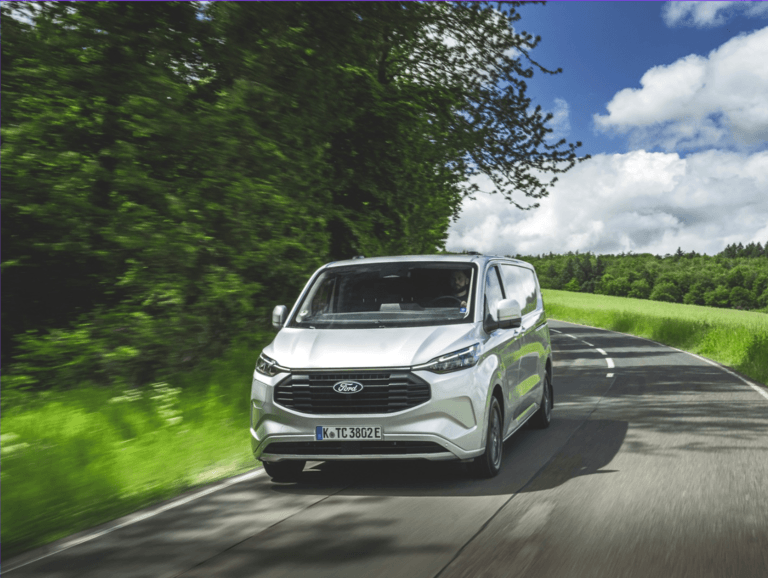
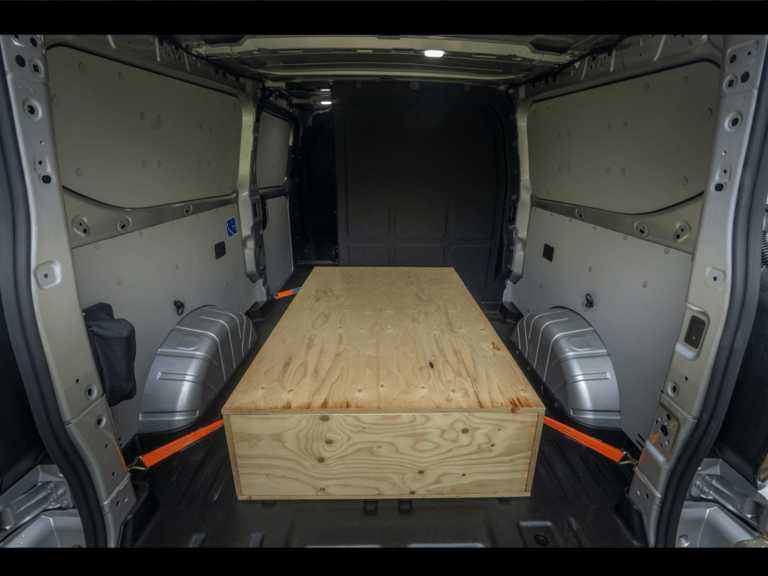
Mirroring the majority of the diesel Custom range, Custom PHEV is offered in L1 and L2 lengths (short and long wheelbase), and a standard roof, the high roof variant previously available on the Custom prior to its most recent facelift is not yet offered on any new Custom. Most trim levels are there, just the entry level Leader and Trail derivatives not appearing on the price list. There’s just a single GVM (Gross Vehicle Mass) option, the higher 3200kg providing optimum payload.
L1 provides 5.8 cubic meters of volume in the loadspace, L2 adding a further cubic metre. Payloads are up to 1350kg, and there’s a pretty impressive towing capacity of 2300kg.
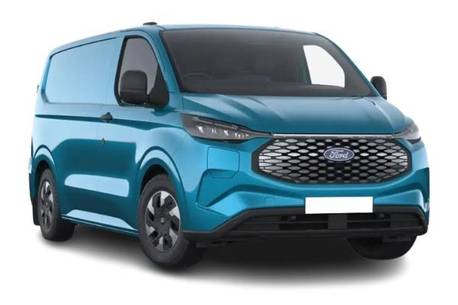
We’re all familiar with the latest Transit Custom and, apart from badging, there’s little to distinguish the PHEV from the diesel van. It could never be described as an ugly duckling with its imposing front grill and narrow headlights. The rear of the van was much improved with the last facelift, and it would be hard to argue that the Custom isn’t one of the best looking vans on the road
Let’s jump to the area that most will be interested in – what’s underneath that smart body. Responding to the criticism levelled at the previous Custom PHEV, Ford hasn’t done things by half.
Sharing a drivetrain with the popular Kuga PHEV, the Custom has a 2.5 litre petrol engine, producing an impressive 232PS. This works in harmony with an electric motor and a modest, 11.8kWh battery, intelligently providing a blend of petrol and / or electric power. The van isn’t designed for running for long distances on purely electric power (a selectable option), but, from fully charged you’ll get up to 35 miles of quiet, emission-free driving. Although the engine will charge the battery pack when conditions allow, you’ll struggle to achieve a full charge, the plug-in facility being designed to top the battery up to the brim from a home or public chargepoint.
Is the PHEV more economical to run compared to the diesel Custom? Quite possibly, but it depends on a number of factors. Calculating MPG is fraught with difficulties with a hybrid powertrain. Official test cycles insist that power being taken from a plug-in source is included in the calculations, something many operators will rarely use. If the petrol engine alone is used, a creditable figure of 39.8 mpg is the result under WLTP Combined test conditions. Using what Ford calls a ‘weighted’ overall test result, it claims a massive 176.6mpg. This should be taken with a very large pinch of salt, the fuel consumption on a long motorway trip will be much higher than that on a short, urban delivery route, especially if the battery had been fully charged prior to the journey.
Looking ahead, Transit Custom PHEV owners can expect to pay less to enter some low or zero emission zones in our towns and cities. The van is classed as a ULEV (Ultra Low Emission Vehicle) and, as such, for example in Oxford which has a zero emission zone, the charge is half that that a Euro 6 diesel van driver would have to pay.
A quick press of a button and the word ‘Ready’ on the dash tells you you’re good to go. The automatic transmission selector is a column mounted stalk, and selecting ‘D’ sees you move away, normally under almost silent electric power. With the correct display mode selected you can see whether the van is under electric, hybrid or petrol power, this can sometimes be the only way you can tell, the changes in configuration being seamless and otherwise virtually undetectable.
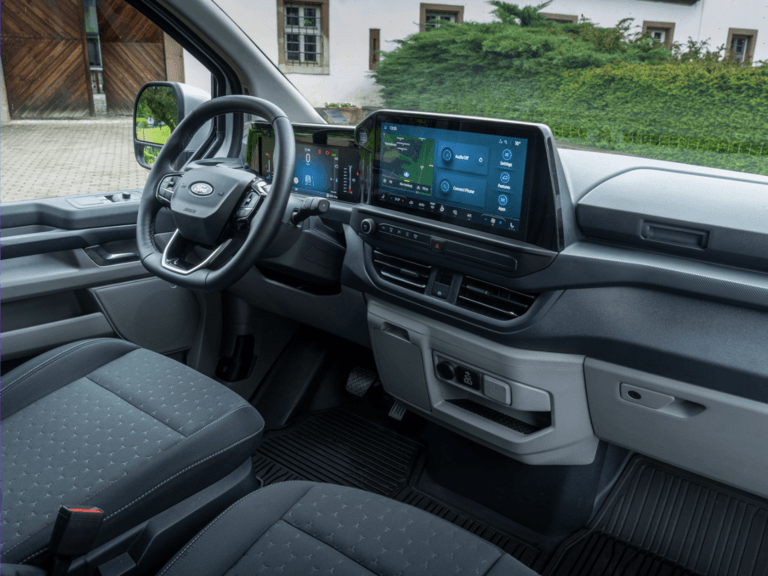
The SYNC4 multimedia screen dominates the centre of the dash and offers the driver various drive modes, favouring fuel economy or to cope with challenging driving conditions such as slippery surfaces, or when towing. There’s even a Sport mode. Although the van will always start in the default ‘Auto EV’ mode. It can be changed to ‘EV Now’ when pure electric operation is required, or, ‘EV Later’, favouring petrol power, conserving the battery energy for future use.
This van is extremely refined and quiet, although put your foot down and there is a sporty ‘growl’ from that petrol engine which isn’t entirely unpleasant. Other sources of noise, such as tyre and wind have been almost eradicated unless the van is being driven at speed.
This review is intended to focus on the PHEV drivetrain but, brief mention should be made about the cab. It’s been designed with the driver in mind, from the ‘square’ (not quite) steering wheel with an optional fold-flat facility giving the driver a place to work, to the flat cab floor offering an obstruction free surface for packages, or for cross cab access. There are plenty of cubby holes and areas for storage, and quality materials have been used throughout.
Equipment levels improve as you move up the range, but all drivers will benefit from the 13” screen with smartphone integration, together with air conditioning and cruise control.
These days, a 3 year / 1000,000 mile warranty can look a little modest compared to the packages offered by others, but the service interval of 2 years or 25,000 miles is competitive.
There’s a lot to be said for electric vans, particularly with regard to the cost of fuel / charging. But, for those wanting to get away from diesel, especially those concerned about the durability of the ‘wet belt’ in the Custom, the PHEV has pretty much everything. A sublime driving experience, little or no range anxiety and an excellent payload. And, easier access to those zero-emission zones. Ford has done an excellent job here, and there’s no doubt that the Custom PHEV, if driven by an otherwise prospective diesel van buyer will convert them in a breath…