Read our reviews...
9am to 6:30pm Monday to Friday | Saturday 9:30am to 1:30pm
Call Get an instant quote
*Price Guarantee *Free Delivery *Personalised Finance

Read our reviews...
*Price Guarantee *Free Delivery *Personalised Finance
Electric Vans / Electric Van Reviews / Kia PV5 Cargo Review
Kia’s first venture into the UK van market has certainly turned some heads. Our Van Expert Tim Cattlin has driven this newcomer and offers his opinion of a potential game changer…
Given the immense success that Kia has had in recent years, it’s little surprise that the company looked at the potential for introducing a range of electric vans. Back in 2024, the PV5 was unveiled for the first time as part of the company’s PBV (Platform Beyond Vehicle) strategy and although additional vehicles are promised in the future, the PV5 is the first to reach the showrooms.
The PV5 fits into the category of ‘small’ vans, and although it’s clearly bigger than the likes of the Ford E-Transit Courier it’s smaller than a Vauxhall Vivaro Electric, occupying a sub-sector of ‘large small vans’ which is dominated by the Volkswagen ID Buzz Cargo. It’s a van with a relatively large load volume but with a modest payload – ideal for those who need a little more loadspace but don’t want to progress to the typical medium sized van.
Kia has made things simple. The PV5 Cargo (there are also passenger carrying versions) is offered in a single bodystyle, there’s no choice of alternative lengths or heights at present but these are in the pipeline. Simplicity continues with just two trim levels, and, apart from colour and optional equipment, the only other decision the customer needs to make is which of the two battery packs to choose from, although this selection dictates the power output from the electric motor.
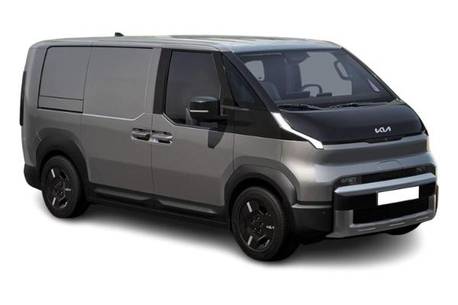
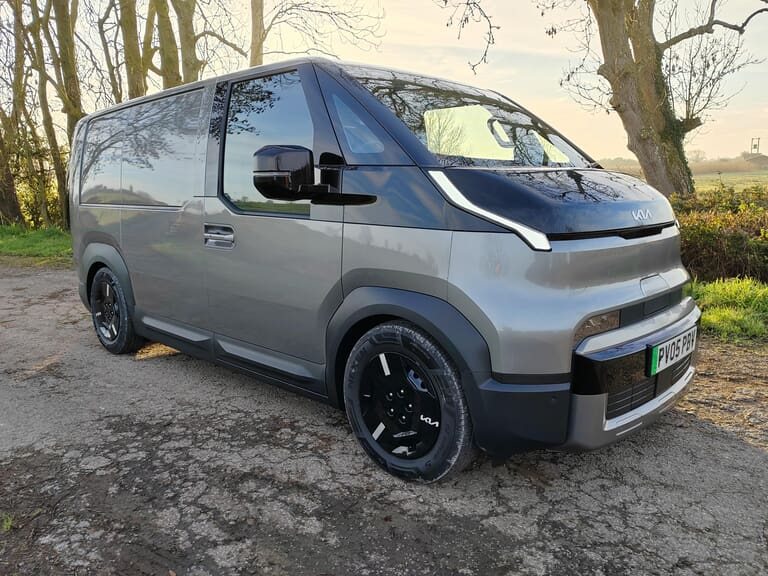
Looks are subjective but, I think the PV5 looks great. Futuristic, stylish, cutting edge are all superlatives that come to mind. Practicality hasn’t been overlooked in the design of the van. A three-piece front and rear bumper design allows individual sections to be replaced independently, and the corner bumper panels can also be removed and interchanged, along with the wheel arch cladding. The front of the van steals the show, the front bumper together with vertically mounted daytime running lights creating an almost dramatic entrance, and the gloss black around the side windows continues through to the wings and bonnet adding to the effect.
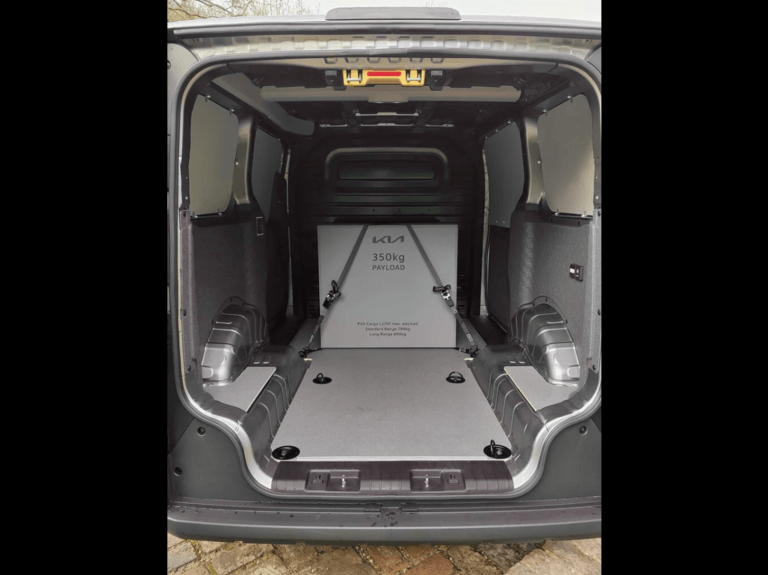
The standard access configuration is via a single side loading door (a second is optional) and twin rear doors. We’ve already touched on weights but there’s a 750kg towing capacity to add to the mix, too. Loadspace dimensions are critical to some, so let’s just mention the 2255mm length, 1565mm max width (more on this shortly), and a height of 1520mm. Side load door width is a relatively modest 775mm, the rear doors offering up to 1343mm. Total load volume is 4.4 cubic metres.
The wheelarch intrusion into the loadbay is only part of the obstruction that anyone loading the van will have to deal with. A penalty of having a low (419mm) step height leaves the rear suspension with nowhere to go so, a fair proportion of the loadspace has a maximum width at floor level of just 920mm.
One thing to watch, the housing containing the rear door latch, located centrally in the top of the aperture protrudes down by around 10cm, an easy target for someone’s head if they’re not careful.
For any manufacturer designing an electric van, there’s a balance to be had between payload and range due to the weight of the battery pack. Kia offers a standard range, 51.5kWh battery, providing a WLTP Combined range of 184 miles, and a long range option with a capacity of 71.2kWh giving 258 miles on that official test cycle. You’ll have around 790kg of payload with the standard range setup, but the extra weight of the long range van drops this by around 100kg.
Although there are two power outputs on offer, you’ll need to opt for the long range van to get the more meaty, 160hp motor, otherwise the van will come with the 120hp version. Top speed is limited to 84mph on both, but there’s around a 4 second difference in the 0-62mph acceleration time between the two. Power is provided to the front wheels, and both versions offer 250Nm of torque from the get go.
The PV5 has a maximum DC charge rate of 150kW and, when plugged into a public chargepoint offering this speed, both variants can be topped up from 10% to 80% in under half an hour. At home or the workplace, an 11kW AC charger can get the smaller pack from 10% to 100% in 4 hours 45 minutes, the larger one taking 6 hours 20 minutes.
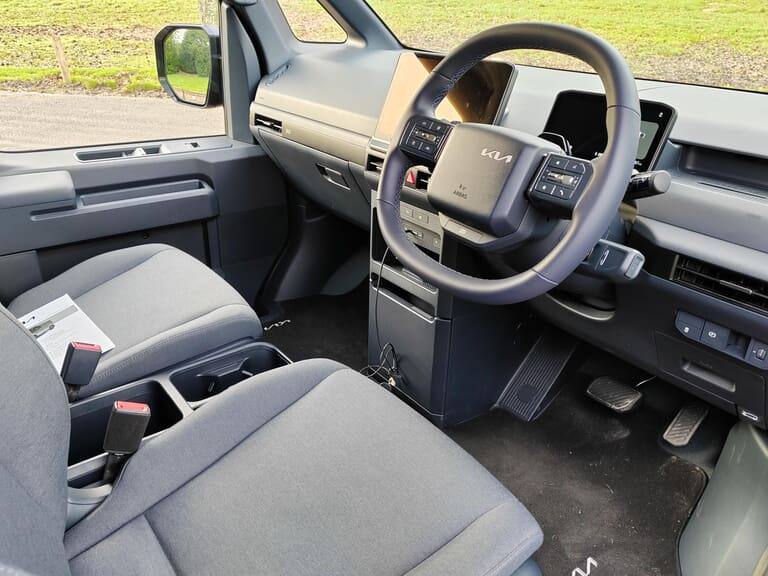
It’s here where the PV5 shows that it’s a small van. If you’ve come out of a Transit Custom and stepped into the Kia, you’ll notice a big difference. Whilst it’s not cramped, it feels much more like a Transit Connect or Citroen Berlingo in size. There’s little prospect of the manufacturer ever offering a dual passenger seating option, it just wouldn’t work.
Apart from the digital drivers display and the multimedia screen, the cab environment is functional but unremarkable. There’s a modest amount of space for those bits and pieces, and visibility to the front is excellent. Side windows allow a partially obscured vista but Kia has included some beefy door mirrors which help when manoeuvring.
Quality of materials is good but this doesn’t quite feel like a premium cabin environment.
Kia has blessed the entry level ‘Essential’ PV5 with the majority of spec that a driver would expect. That 12.9” touchscreen has wireless Apple CarPlay and Android Auto connectivity, and air conditioning keeps the occupants comfortable. Legislation means that Kia has included all the latest safety and driver aids such as lane keep assist and speed limit assist together with smart cruise control. You’ll also get front and rear parking sensors and a reverse camera.
Opting for the Plus model adds electrically folding door mirrors, heated seats, a 240 volt socket in the cargo area and wireless phone charger. There are also a couple of extra safety features, such as rear cross traffic collision avoidance.
Fortunately, I was able to drive the two battery / power combinations back to back, which allowed me to get a feel for the difference between the two. To be frank, there didn’t seem to be much, albeit the vans only had around half the maximum payload in the back. If you don’t need that extra range, I personally wouldn’t opt for the long range purely to get that extra 40hp. The PV5 isn’t the nippiest electric van on the road, others provide a lot more power (which isn’t really necessary) but, on my test route, a mix of urban and country roads, even the standard range van performed perfectly adequately.
The van handled well, nimble when pushed, even with that load in the back. Whilst noise levels were as low as you would expect in an electric van, the Kia not suffering from excess tyre or wind noise, all the vans I drove suffered from some sort of booming resonance from the suspension which proved tiring. In the van’s defence, I discussed this with others who had driven the van, and they hadn’t noticed it.
With forecast second hand values being high, meaning low depreciation, a 7-year / 100,000 mile warranty (8 years for the battery) and 2-year / 20,000 mile service intervals, the PV5, if charged away from expensive public chargers could potentially be the van with the lowest running costs of all.
If the loadspace / payload works for you, the PV5 is, quite frankly, a no brainer. It looks great, drives well, has a decent range between charges and promises to be cheap to run. Yes, it’s not quite as premium in feel as its closest competitor, the VW Buzz Cargo, but check out the £9200 difference in list price… This, coupled with those excellent residual value (second-hand) forecast values makes the PV5 very hard to ignore…