Read our reviews...
9am to 6:30pm Monday to Friday | Saturday 9:30am to 1:30pm
Call Get an instant quote
*Price Guarantee *Free Delivery *Personalised Finance

Read our reviews...
*Price Guarantee *Free Delivery *Personalised Finance
Electric Vans / Electric Van Reviews / Top 5 Electric Vans By Range
So you’ve decided that you’re ready to move over to an electric van. Great! But which one do you go for? What do you need to look for to work out which is the best electric van for your operation? One of the most important factors for many is the range that the van can cover on a single charge. Our Van Expert Tim Cattlin takes a look at the top 5 electric vans by range, to help you make the right choice.
OK, before we start, there are a couple of caveats we need to get out of the way. Firstly – range isn’t everything. You may also need maximum payload, the biggest load volume or a van with a powerful motor so you might need to compromise here and there to get the best possible combination. The second thing to bear in mind is that the new electric van landscape is constantly changing, with new and improved products being launched regularly, and so whilst this article is bang up to date right now, rest assured it won’t be before too long – I’ll endeavour to update it periodically though.
Without further ado, let’s crack on with the top 5 electric vans by range. All figures are the manufacturer’s WLTP Combined Cycle test results as published, and do bear in mind that these numbers are for comparison purposes only, and in real world driving with a load on I’d expect that you’ll rarely achieve them.
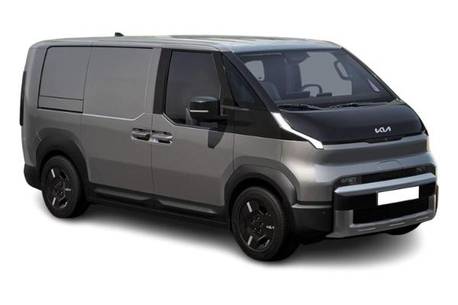
The Kia PV5 has rocked the van world with its fabulous looks, excellent driving characteristics and 7 year warranty. Add to this the 258 miles available on a full charge with the 71.2kWh battery in the long range option (even the standard van provides 184 miles before you need to charge it up) and you’ve got a proposition that takes some beating. The long range van comes with a 160hp motor, 40hp more powerful than the van with the standard 51.5kWh battery. The Kia, fitting into the ‘large small van’ category only has one serious competitor, the Volkswagen ID Buzz Cargo (read more here). The long range van has a maximum payload of around 690kgs so, if you need a little more you’ll need to opt for the standard van. Load volume is 4.4 cubic metres.
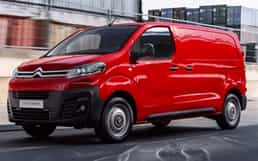
The Stellantis range is represented here by the Citroen e-Relay. This van has, in diesel guise proved itself over many years by being a trustworthy, dependable workhorse. When Stellantis designed the electric version, these attributes were crucial to retain and the company has done the job well. All e-Relays have an official range of over 235 miles and if you opt for the L3H2 model, you’ll benefit from the van with the optimal range. As the van is plated at 4250kg, it’s got a massive 1480kg of payload in its 13 cubic metre loadspace, and the 270hp motor will make sure you get to your destination quickly as well as economically.
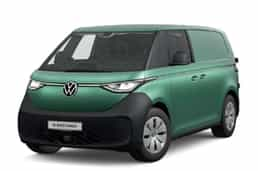
This is the van that manages to look futuristic but retro at the same time. Although it has the appearance of a medium sized van, its dimensions and payload are perhaps more akin to a long version of a smaller van, for example the Caddy Maxi. You’ll get 707kgs of payload in the loadspace which, in its single body length has a volume of 3.9 cubic metres.
Volkswagen achieves this range by fitting the van with a newly improved 79kWh battery (a smaller 59kWh version is also available), the weight of which possibly explains the modest payload. The 204PS motor in such a light van makes for rapid progress and, once again in my experience with an example supplied by Volkswagen, the van is a pleasure, in fact, fun to drive. A real head turner, too.
Taking joint second place is the eSprinter, Mercedes-Benz finally having a large electric van with a competitive range, the original struggling to cover 100 miles before running out of charge. The van is available with two battery options, 81kWh and 113kWh, and two power outputs from the motor. Offered in L2 and L3 body lengths, it’s the L3 model with (unsurprisingly) the larger battery that will achieve that 277 miles test result. Just a word of caution though, this range comes at a price. Despite the van having a 4250kg GVM, the payload is just 1008kgs, significantly below most of the competition, something to watch if you need to carry weight. Other vans in the range (with the smaller battery) have capacities up to 1278kg.
Topping the chart at the time of writing is the excellent offering from Renault. There’s just a single motor / battery combination and, whilst on paper the 140hp output from the motor and the 87kWh battery might seem modest, in reality the drivetrain just works. Renault’s designers have spent a huge amount of resource on aerodynamics which means that the Master, despite being a large van cuts through the air efficiently, helping the van achieve that class-leading 285 mile range. Even at 3500kg GVM the payload is up to 1125kg, and selecting the 4000kg GVM option adds another 500kg.
Renault has won a number of industry awards with the Master E-Tech and it’s easy to understand why. There’s no aspect that it doesn’t do well, and the fact that it’s topped our table adds to the argument that, in its sector it’s the one to beat.
 Ask for AvailabilityVw Id Buzz CargoId.buzz Cargo 150kW 77kWh Commerce Auto
Go to deal
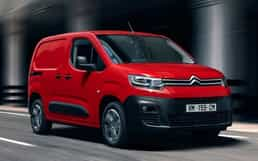 Ask for AvailabilityCitroen Berlingoe-BERLINGO Van 800 M 50kWh Enterprise Pro
Go to deal
 Ask for AvailabilityPeugeot E-Expert100kW 75kWh 11kW Professional/Pm
Go to deal
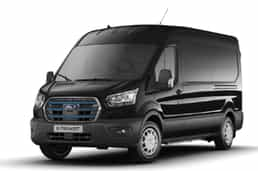 Ask for AvailabilityFord E-Transit350 L2H2 68kWh 184ps Trend
Go to deal