Read our reviews...
9am to 6:30pm Monday to Friday | Saturday 9:30am to 1:30pm
Call Get an instant quote
*Price Guarantee *Free Delivery *Personalised Finance

Read our reviews...
*Price Guarantee *Free Delivery *Personalised Finance
Electric Vans / Electric Van Reviews / Volkswagen e-Transporter Review
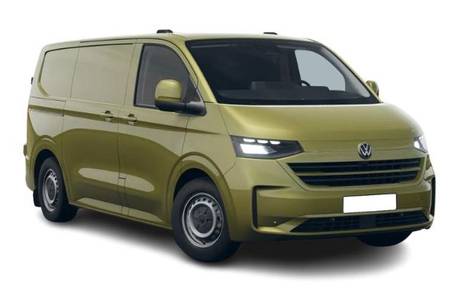
Not only does Volkswagen’s iconic Transporter get a new shape, it also gets a brand new fully electric drivetrain. Our Van Expert Tim Cattlin takes a look…
It’s little secret that diehard Volkswagen Transporter enthusiasts were somewhat underwhelmed that the latest incarnation of the van was to be the result of a platform sharing deal with Ford, the van being more or less a rebadged Transit Custom. But, the Ford has earned its place as Britain’s top selling van year after year so the arrangement makes commercial sense for the German manufacturer.
What this did bring to the table was a ‘proper’ electric van to the Transporter range. Whilst the T6.1 was offered as an electric van, this was more of an aftermarket conversion with limited range and payload. As a result, the ABT-e didn’t sell in big numbers.
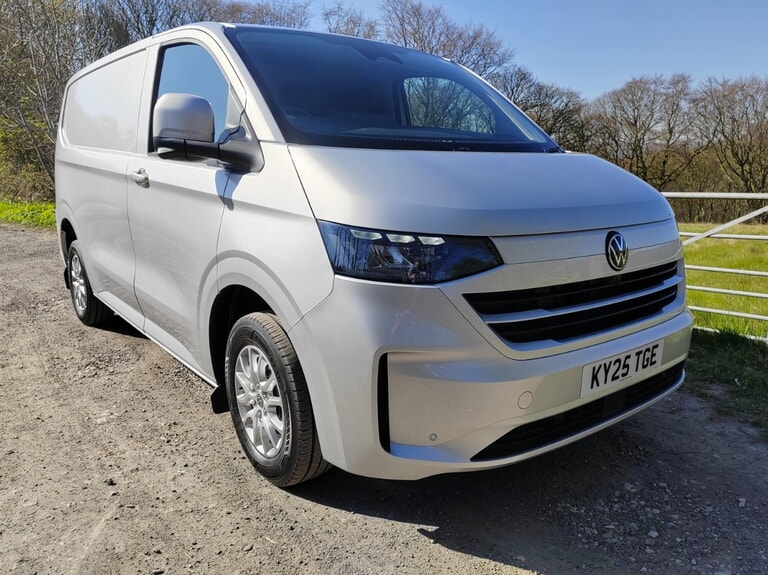
It’s pretty straight forward. In panel van form, there’s a choice of short or long wheelbase with just a standard roof line. The SWB is badged T32, hinting at the van’s GVM (Gross Vehicle Mass) of 3200kg, whereas the LWB benefits from an additional 200kg of capacity, being designated the T34. Although the diesel van is offered at three trim levels, the e-Transporter has skipped the entry level Commerce spec, only being available at the Commerce Plus and Commerce Pro trim points.
The popular Kombi crew van mirrors the van, except that the LWB retains the lower weight T32 tag.
The single electric motor is offered at three different outputs, 136PS, 218PS and, on the Kombi van only, 286PS. There’s just the one battery option, a 70kWh pack mounted under the floor. On the panel van, the 136PS version has a 0-62mph acceleration time of 12.8 seconds and a restricted top speed of 70mph. Under the WLTP Combined test cycle, the e-Transporter achieved a maximum range of around 224 miles although as ever, this should be treated with caution, real world driving conditions, payload and weather all play their part in bringing the useable range down.
Opt for the 218PS motor and, you’ll take 8.6 seconds to achieve that 62mph sprint, and the top speed tops out at 93mph. The range dips slightly to around 210 miles.
For the ultimate in e-Transporter performance, the 286PS motor available in the Kombi gets that 0-62mph time down to 7.4 seconds, but the top speed is capped at 93mph. Range is 205 miles.
As the battery pack is identical on all models, the charging times are the same. Most will use a home or work 7.4kW wallbox charger, and that will get the van from 0-100% of capacity in just under 10 hours. If you’re out and about and plug into a 125kW DC public chargepoint, you’ll have to wait just 40 minutes to get from 10% to 80%.
The electric van designer’s nightmare. Balancing electric van payload with range, the size of the battery impacts both. Traditionally, those wanting a medium sized diesel van will expect around, or a little over a 1000kg load capacity. Fair play to Volkswagen, and its Ford partner, all models of the e-Transporter panel van have a minimum payload of 996kg, up to 1076kg. Towing capacity is also impressive, with all vans being able to cope with a 2300kg trailer (expect that range to be crippled if you operate the van at its maximum train weight of 5350kg, however).
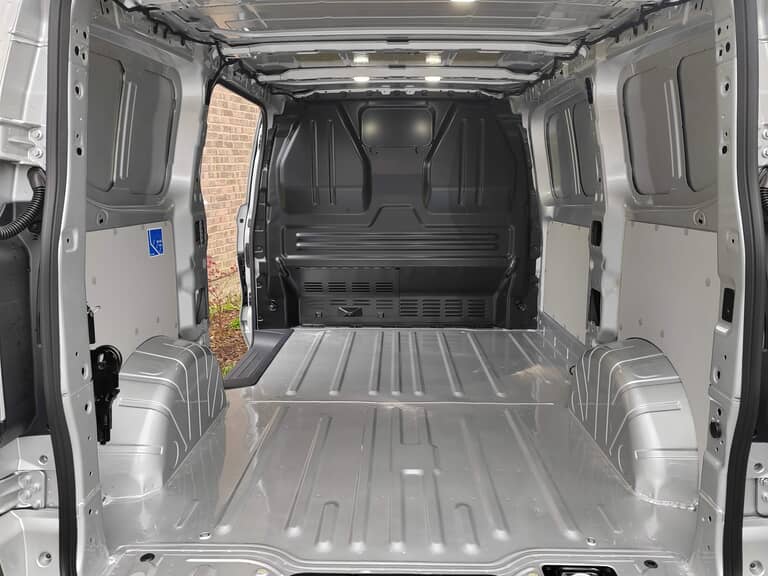
Loadspace dimensions are pretty typical for a medium van, SWB having a load length of 2602mm, rising to 3002mm for the longer van. Width is 1777mm max with a load height of 1316mm. Loadspace volume is 5.8 cu/m for the SWB, the LWB having an additional cubic metre.
The standard door configuration is twin rear and a single side loading door, but there are options for a tailgate and an additional side loading door.
At Commerce Plus level the e-Transporter boasts a reasonable amount of equipment. Highlights include LED headlights and daytime running lights, some body-coloured parts to the van exterior, including bumpers, and in the cab and inside there’s a 13” multimedia display including Apple and Android smartphone integration. All the now mandatory driver assistance and safety tech is there including cruise control with predictive speed limiter, lane assist and rear parking sensors. There’s the now to be expected air conditioning present and correct, too, together with heated seats. In the load area, there are the very welcome LED lights and a steel bulkhead.
Commerce Pro adds silver alloy wheels, power folding mirrors, adaptive cruise control, wireless phone charging and a front, rear and side view camera arrangement. There are also additional LED lights in the loadspace
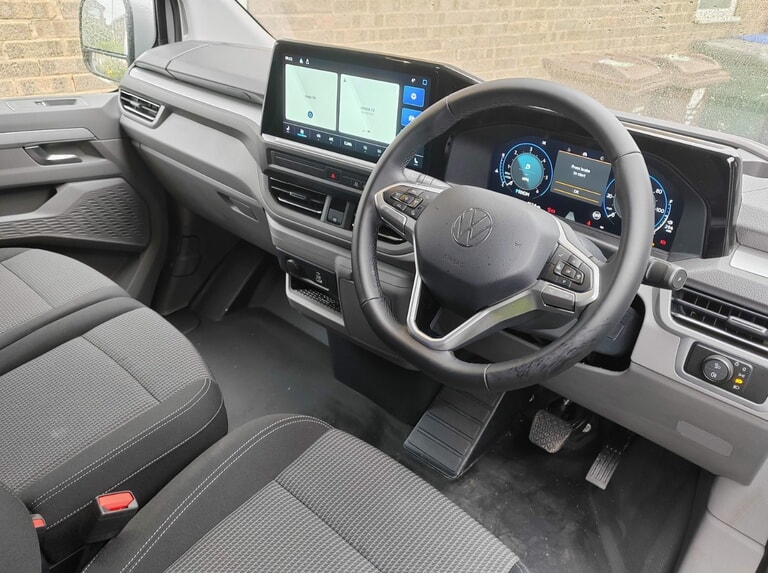
Proven already in the Custom, the cab has been designed around the driver and the demands of a full working day. Storage is well catered for, with the usual spaces in the doors, dashboard, and overhead areas. The centrally mounted 13-inch multimedia screen is sensibly angled towards the driver, while the crystal-clear 12-inch digital instrument cluster, which is larger than Ford’s offering, can be customised to display the information the driver wants to see during everyday use.
A flat cab floor makes access easier for passengers and, when travelling alone, allows the driver to carry boxes without a raised centre section compromising stability. The centre passenger seat also folds down to create a useful table or writing surface, with extra storage available beneath.
I’ve driven a van fitted with the lower powered motor and found it wanting for little. On a route with a mix of roads it performed extremely well, albeit the vehicle was unladen. What is always noticeable on an electric van is the availability of all the torque from the get go, something much appreciated by drivers using a van that is fully loaded. There are more powerful electric vans on the market, but under normal circumstances I think that most drivers would be more than happy with the 136PS under their right foot. Road and wind noise is hardly noticeable, something that the designers should be congratulated on as an electric powertrain often throws up issues that a diesel engine would drown out. The steering is light but positive, and the van handled well.
Vans, which are very similar with the exception of the badge, are often hard to choose between. But, Volkswagen has, at the time of writing, a package that may well tempt customers who were otherwise heading for their local Ford dealer. VW offers with every Transporter a ‘5+ Promise’. It includes a 5 year, 124,000 mile warranty, 5 years roadside assistance, 5 routine services and 3 MOT tests.
Opting for the Plus model adds electrically folding door mirrors, heated seats, a 240 volt socket in the cargo area and wireless phone charger. There are also a couple of extra safety features, such as rear cross traffic collision avoidance.
The e-Transporter is a van very hard to find fault with. A competent load carrier, a decent electric range, a modern, well designed and well equipped cab and a great after-sales package. Not only this, it’s a pleasure to drive. I’d certainly buy or lease one.